Blog dedicado a toda a iconografia e memorabília dos diversos Nacionalismos Europeus. (1926-1945)Dirige-se essencialmente a coleccionadores e curiosos desta temática bastante rica em uniformes, distintivos, e condecorações.
Abrange também o período da 1ª Guerra Mundial (1914-1918)
AVISO: Este não é um blogue de carácter politico.Pretende apenas mostrar alguns aspectos da recente História passada, sem complexos e tabus.Trata-se apenas de um espaço de carácter histórico.
Em 30 anos de coleccionismo, é a primeira vez que vejo um distintivo da Milicia Francesa-conhecida vulgarmente como "LA MILICE".Acabei de o adquirir na Alemanha.Apesar de não estar nas melhores condições, não podia deixar escapar esta raríssima oportunidade.Oportunidades destas não aparecem todos os dias.
O que era a "Milice Française"?
Organização politica paramilitar Francesa criada em 30 de Janeiro de 1943, pelo governo de Vichy, para lutar contra a resistência.Apoiada pelos Alemães, com elementos da Gestapo.
O chefe oficial da Milicia era Pierre Laval, chefe do governo, mas o verdadeiro responsável, era Joseph Darnand, fundador do serviço "D'Ordre Legionnaire"-S.O.L, percussor da Milicia Francesa.
No final da Guerra, centenas de elementos da Milice, foram presos e executados sumáriamente palas FFI.
JOSEPH DARNAND
Capturado em Itália pelos Britânicos, e entregue às autoridades Francesas, foi julgado e executado em 10 de Outubro, de 1945.
Ao contrário do que os filmes de Hollywood contam, os soldados Italianos que combateram na 2ªGM, não eram cobardes, cantadores de ópera, ou comedores de spaghetti....Houve situações que até se comportaram melhor que os "miticos" soldados Alemães, caso da Batalha de El Alamein, no Egipto, em Outubro de 1942, em que os Italianos, aguentaram as linhas até ao máximo do limite das suas forças, enquanto os Alemães fugiram em direcção à Libia, utilizando os poucos transportes que dispunham, abandonando assim os seus camaradas Italianos à sua sorte.O capacete que hoje publico, trata-se de um capacete Colonial Italiano, pertencente à 40ª Regimento de Infantaria, regimento este fazendo parte integrante da Divisão Bologna,(25ª Divisione Fanteria autotransportabile) divisão esta que combateu precisamente na Batalha de El Alamein.
Óculos originais de época, usados no Deserto
Antes de mais deixo-vos a história desta Divisão, (em Italiano)
Origini e vicende organiche
Trae origini dalla Brigata "Vittorio Emanuele" costituita nell'estate 1859 e sciolta nel 1871. In esecuzione della legge 11 marzo 1926 sull'ordinamento dell'esercito, che prevede la costituzione delle brigate su tre reggimenti, il 14 novembre assume la denominazione di XXV Brigata di Fanteria che passerà successivamente a far parte della 25a Divisione Territoriale di Napoli. Nel 1934 questa G. U. prende il nome di Divisione di Fanteria Volurno (25a). Il 27 aprile 1939, ricostituito il 39° e 40 Rgt. Fanteria, con il 10° Rgt. Artiglieria, successivamente sostituito dal 205° Rgt. Artiglieria, viene costituita la Divisione di Fanteria Bologna (25a).
Guerra 1940-43
1940 - Il 10 giugno la Divisione Bologna risulta essere schierata sul confine libico-tunisino. Successivamente, al termine del conflitto con la Francia, riceve ordine di trasferimento per insediarsi a sud di Tripoli in località Bir el Ghnem.
1941 - All'inizio dell'ansa la maggior parte delle unità della divisione sono ancora schierate a difesa del campo trincerato di Tripoli nella zona di Garian, mentre alcune di esse, specie artiglierie, vengono inviate sul fronte di combattimento e schierate lungo la linea Derna-Mechili. In questa zona partecipano ai combattimenti dal 25 al 23 gennaio e al successivo ripiegamento su Barce, Bengasi fino a Ghemines dove giungono il 5 febbraio. In marzo tutta la divisione si trasferisce nella zona di Sirte e sostituisce le unità spinte in avanti nel corso della offensiva italo-tedesca. A fine maggio la Divisione Bologna viene spostata sul fronte di Tobruk dove concorre all'assedio della piazzaforte partecipando ai vari infruttuosi tentativi per l'occupazione della città. Passata l'iniziativa all'avversario ne respinge il 21 e 22 novembre a Sii Rezegh gli attacchi portati con forti colonne motocorazzate provenienti dall'Egitto. Il 23 aspri combattimenti si accendono sul caposaldo di Bir Garsa che viene più volte perduto e riconquistato. Il 25 un ulteriore violento attacco nemico riesce ad aver ragione della difesa del caposaldo di Belhamed e ad aprirsi un corridoio fra le unità della divisione. Con questa riuscita manovra le truppe inglesi conseguono un duplice risultato: il ricongiungimento con le forze assediate a Tobruk e l'accerchiamento delle unità della divisione schierate a nord verso la costa. Attacchi e contrattacchi sempre più violenti si susseguono dal 27 novembre al 5 dicembre allorché i reparti superstiti della divisione danno inizio a una manovra di ripiegamento verso El Adem e Ain el Gazala prima e Derna poi. L'11 dicembre in quest'ultima località la Divisione Bologna riordina le unità e si schiera a caposaldo, quindi profilandosi la minaccia di aggiramento da sud ripiega ancora verso Agedabia ed El Agheila. 1942 - Nel primo semestre i reparti della divisione rimangono nella zona di Agedabia. A metà luglio la Divisione Bologna è schierata a sud-ovest di El Alamein nella zona di El Mireir, dove gli italo-tedeschi sono in difficoltà,come elemento di rinforzo. Il 18 luglio entra in territorio egiziano. Il 30 agosto attua un movimento offensivo verso est e partecipa alla battaglia di Alam Halfa a sud di El Alamein. Dopo i primi parziali successi, viene arrestata e subisce i successivi contrattacchi inglesi che terminano il 7 settembre. Dal 23 al 31 ottobre il nemico sottopone le posizioni tenute dalla divisione a intensi bombardamenti aerei e terrestri e a reiterati attacchi di mezzi corazzati. Il 2 novembre la Divisione Bologna arretra sul margine ovest di Deir el Beida e dopo una ulteriore accanita resistenza il 4 tenta con disperata manovra di sottrarsi alla morsa che si sta per chiudere alle sue spalle. Il tentativo non riesce e parte delle unità della divisione raggiunte durante il movimento e attaccate separatamente vengono annientate. Alcuni nuclei riescono ancora a tener testa al nemico il 5 novembre a sud di Abu Aggag, il 6 a Fuka e poi a Marsa Matruk dove in successivi violenti scontri vengono però sommersi il 21 novembre. La Divisione Bologna viene sciolta il 25 novembre per eventi bellici. Alcuni suoi reparti furono aggregati a quelli che si ritirarono in Tunisia dove operarono fino al febbraio 1943.
Publico hoje um pendão em seda da Legião Condor, onde são apresentadas todas as bandeiras que fizeram parte ou apoiaram a causa Nacionalista durante a Guerra Civil de Espanha, de 1936-1939, onde se constata a presença da bandeira Portuguesa.
Era normal em algumas unidades alemãs, fazerem este tipo de pendões, utilizando-os como peças de decoração, podendo variar os nomes do combatente e da unidade.
Para quem não saiba os números dos combatentes que combateram ao lado do "BANDO NACIONAL", foram:
( Foto retirada da Revista Francesa "Uniformes" nº293)
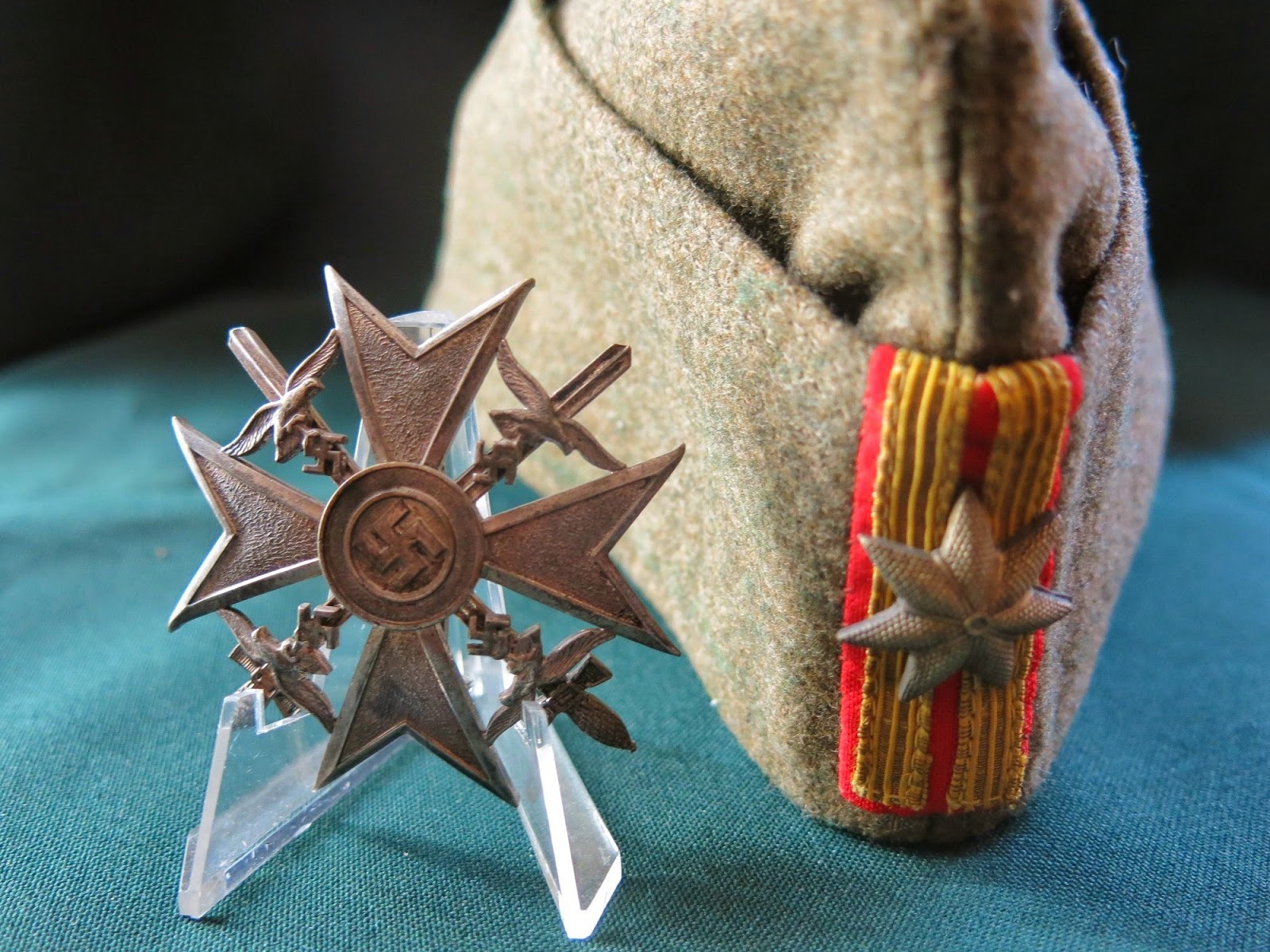
BIVAQUE E CRUZ DA LEGION CONDOR
( COLECÇÃO VIRIATOS MILITARIA)
O bivaque acima na foto, esteve presente em ambas as paradas de Hamburgo e Berlim.
Foram expressamente fabricados para o evento, pelo RAD. (Reichs Arbeit Dienst)
O contingente Alemão proveniente de Espanha foram transportados pelos navios de passageiros do KDF "Wilhelm Gustloff" e "Robert Ley" chegando a Hamburgo, no dia 30 de Maio de 1939, tendo sido recebidos em festa pelo chefe da Luftwaffe Alemã, Herman Goering.
VIDEO CHEGADA A HAMBURGO 30 MAIO 1939
Em 6 de Abril de 1939 a Legião Condor foi deslocada para Berlim onde desfilou e assistiu ao seguinte discurso por parte de Adolf Hitler: (Traduzido para Inglês)
VIDEO PARADA DE BERLIM 6 DE JUNHO DE 1939
DISCURSO DE A.HITLER:
Berlin, June 6, 1939
My Comrades! Finally I
am able to greet you now in person.
I am so happy to see you here before
me, and above all I am so proud of you! And at this hour the entire German
people feels as I do. All those millions who are experiencing at the loudspeaker
and in spirit your entry and reception take you into their hearts, filled with
gratitude and joyfully moved that again you are with us in the
homeland.
In the Summer of 1936, Spain appeared to be lost. International
forces fanned the fire of a revolution which was certain to reduce to ruins not
only Spain but Europe as well. Even the Christian Democrats insisted on
delivering for this purpose, weapons fuel, and so-called volunteers. A
dreadfully threatening fate raised itself over our continent. The most ancient
cultural lands of Europe appeared to be endangered. From Spain itself tens of
thousands of Germans had to flee. Their worldly goods fell victim to the
destruction. Many were murdered. What the Germans there had built up in a
laborious, long, honest battle for life as the basis of their existence was
destroyed and annihilated in just a few weeks.
German warships, which I
immediately sent to Spain in response to the cries for help from our racial
comrades, attempted to assist, as they -- at least as well as could be -- took
over the defense of life and limb and enabled the removal of our racial comrades
to the homeland. Then arose ever more clearly in this land a man who seemed to
be called by the command of his own conscience to act for his
people.
Franco began his struggle for the salvation of Spain. Against him
arose a conspiracy fed from around the world.
In July 1936, I had
resolved quickly to respond to the request for help which this man extended to
me and to help him in the same measure and for as long as the rest of the world
would render support to the internal enemies of Spain. With that National
Socialist Germany began to partake actively in the battle for the
reestablishment of a national and independent Spain under the leadership of this
man. I ordered this in the knowledge that I could save not only Europe but also
our own fatherland from a similar catastrophe in the future.
But I also
did this from the deep sympathy for the suffering of a land which once had
remained neutrally friendly towards us in the World War, in spite of all
oppressive attempts on the part of England. With that I have extended the thanks
of the German nation.
This happened furthermore in full agreement with
Italy. Because Mussolini, inspired by the same idealistic considerations, had
likewise made the decision to have Italian assistance sent to the savior of
Spain in his struggle against the internationally organized annihilation of his
land. With that a practical, mutual demonstration of the unified world-view of
our two lands was revealed for the first time.
These idealistic motives
were neither able to be grasped nor wanted to be admitted in the international
plutocracies. For years British and French newspapers informed their readers
that Germany and Italy allegedly had the intention of conquering Spain, dividing
it up, and above all of robbing it of its colonies. Trains of thought which in
any case seem less unnatural in the representatives of these lands than with us,
since the robbing of foreign colonies has always belonged indeed to the
permitted and tested methods of these democracies.
So we recall the
infamous assertions which were spread one day that Germany had landed 20,000 men
in Morocco in order to occupy it and thus take it away from Spain. With these
libels the politicians and journalists of the democracies have agitated their
peoples and have sought again and again to take from Spain the outcome of that
catastrophe which these politicians of encirclement, war-mongers, and
war-profiteers desire most ardently the new great war between the European
peoples.
Now you, my comrades, have returned from Spain. This day of
festive reception in the Reich capital is at the same time the conclusion and
the completion of all these mendacious democratic lies.
Because once I
sent you to help an unfortunate land, to support a heroic man, who wanted as a
splendid patriot to rescue his people from annihilation and has indeed
gloriously rescued it. You are now returned as the valiant executors of my task.
I would like to make it known at this moment to the entire German nation how
much reason it has to be thankful to you. For that service to which you were
entrusted you have reported as honorable and dutiful German soldiers, courageous
and loyal and above all modest. The high praise which the Spanish hero of
freedom has expressed of you can only make the German people but especially
proud of you.
It was painful for us all to have to be silent about your
battle through these long years. But I conceived at that time the idea of giving
you in the homeland after the end of this war the reception which valiant,
victorious soldiers deserve. Today for you and for me my intent is fulfilled.
The entire German people greets you in proud elation and heartfelt
solidarity.
But thanks also are due those who as soldiers have had to
sacrifice life, limb, and health in the service of this mission, and finally
thanks are due to the bereaved families, who mourn their so valiant men and sons
today as victims. They are fallen, but their death and their suffering will
spare the lives of countless other Germans in the future.
No one has more
understanding of this than National Socialist Germany, which, emerging from the
struggle of the World War, itself had to bear in the German rebuilding many
victims to the same enemy. I thank you soldiers of the Legion as well as the
soldiers of the Navy for your readiness for action, for your sacrificial
courage, for your loyalty, your obedience, for your discipline, and above all
for your silent fulfillment of your duty.
Your example, my comrades, will
above all but increase the trust of the German people for you, strengthen the
band of camaraderie with our friends, and leave for the world no doubt that
whenever the international war-mongers should ever desire to realize their
intention of attacking Germany, their attempt will experience from the German
people and the German Wehrmacht a repulse of which the propagandists of
encirclement seem incapable even today of imagining. In this sense as well, my
comrades, your battle in Spain, as a lesson for our foes, was a battle for
Germany.
That you yourselves are now returned as hardened soldiers has
not only sharpened your own appreciation for the achievements of the German
soldiers in the World War, but also made you fit in an equally high measure to
be the examples and instructors of the young soldiers of our new Wehrmacht. Thus
have you helped in strengthening the trust in the new German Wehrmacht and in
our new weapons.
At this moment we also desire to remember on whose side
you have fought. We remember the Italian comrades, who valiantly and loyally
gave their blood and life for this battle of civilization against destruction.
And we remember above all the land itself from which you have just come. Spain
has had to endure an appalling fate. You, soldiers of the Legion, have seen the
destruction with your own eyes. You have experienced the cruelty of this battle.
But you have also gotten to know a proud people, which boldly and heroically has
fought with resolution for almost three years for the salvation of its freedom,
its independence, and, with that, its national existence. You had above all the
fortune to stand there under the command of a general who from his own power of
resolve, unerringly believing in victory, became the savior of his
people.
CIMITÉRIO ALMUDENA MADRID
We all have in this moment only the sincere and heartfelt desire
that the noble Spanish people now might not be begrudged the completion of a
new, proud ascent under the genial leadership of this man.
Legionaries
and soldiers! Long live the German people! Long live the Spanish people and its
leader Franco! Long live the Italian people and its Duce! German people! Long
live our Legion!